CISSP readiness · 8 domains · official weights Free to start · no card

Find out whether you're ready for the CISSP before you pay to find out.

CertStone is a CISSP practice bank built around one instrument: a statistically-grounded estimate of where you stand, weighted by the official exam blueprint, shown with its margin of error. It stays silent until it has real evidence.

The exam is $749 per attempt. The point is that you never book it on a feeling.

Free to sign up, no card needed. Try 25 real questions first.

1,600

original questions

62/62

subdomains covered

8

domains, officially weighted

60

scored answers before any estimate

25

free questions, no card

// The stakes

A $749 shot you only want to take once

Booking it before you're ready doesn't just cost the fee. It also costs the weeks of momentum a failed attempt takes with it. Most candidates decide they're ready on a feeling. This app exists so you can decide on evidence.


The exam you're preparing for

Fee
$749 per attempt, pass or fail
Duration
3 hrs, hard stop
Length
100–150 adaptive items
Passing standard
700/1000, a scaled score rather than a percentage
Partial credit
None for almost passing
What decides your result
The exam itself. Nothing on this page decides it.

// The readiness instrument

Analytics that measure ability, not streaks

"You scored 78% on 200 questions" tells you almost nothing about a three-hour adaptive exam. CertStone estimates your ability instead. It turns that into a probability of passing, always shown with the range it could plausibly be.


Exam readiness

Example: not your data
● Moderate confidence

Likely between 94% and 95% · a converged solution

Fill = estimated pass probability. Violet band = the range it could plausibly be.

Example only. Illustrative pass probability 95 percent, likely between 94 and 95 percent. Not a real score.

An estimate based on your answers in this app. It is not an ISC2 score and not a guarantee of any exam result.

Exam readiness

Example: early on

Not enough data yet, and that's honest

You've answered 22 scored questions across 2 domains. A readiness estimate needs at least 60 answers across at least 3 domains to be honest.

This is what the app shows instead of guessing. That is on purpose.

readiness: rules the number obeys Enforced in code
  • [BAND]Never a bare percentage. It always shows the plausible range plus a plain-word confidence label.
  • [FLOOR]Below 60 scored answers across 3 domains: no percentage at all, just how many more you need.
  • [FIRST]Only your first attempt at an item counts toward ability. Repeats feed the review queue.
  • [WEIGHT]Each domain counts by its official ISC2 weight, the same blueprint every item is tagged against.
  • [TAG]Every item maps to one of the outline's subdomains, so weak spots come back by name.

$ A confident number built on twelve answers is worse than no number.

CertStone estimates how hard a question you can reliably answer, weighted by how much each domain actually counts on the real exam.

Because every item is tagged to its specific subdomain, your weak spot comes back as "asset retention and destruction", not "somewhere in Domain 2." That is the difference between knowing you are weak and knowing what to open a book to.

// What a student sees

"Study more" becomes "study this."

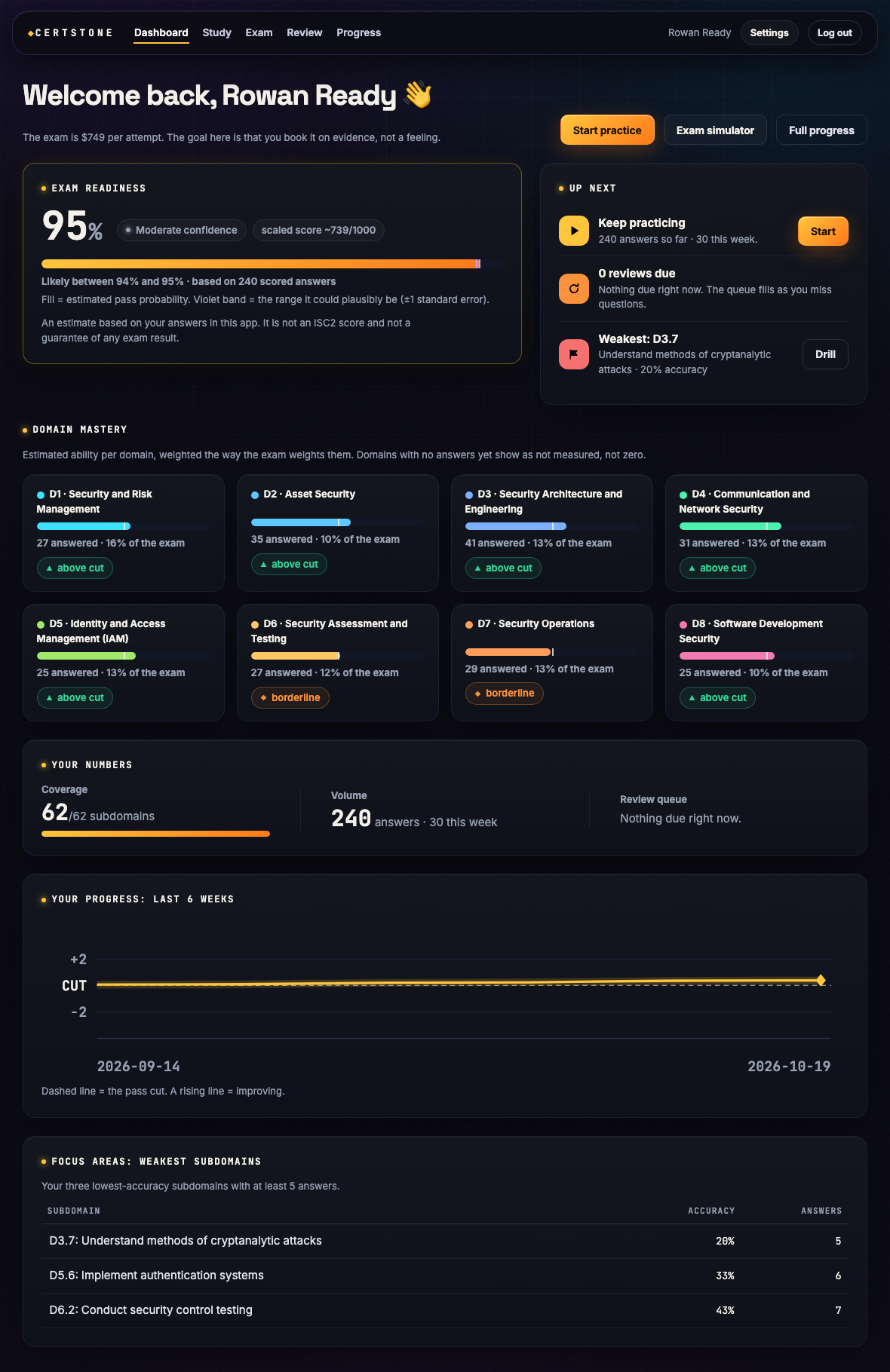
Overall readiness with its confidence range, per-domain ability measured against the 700 cut, and how much of each domain has actually been covered.


The CertStone readiness console of a student who is ready: a readiness estimate of 95%, likely between 94% and 95%, with a moderate-confidence label; a per-domain mastery board showing six domains above the cut and two borderline; a stats row showing all 62 subdomains covered across 240 answers; a six-week progress line holding above the cut; and the weakest subdomains listed by accuracy. All figures are from a demo account.
  • Readiness with its range

    The estimate, the band it could plausibly sit in, and a plain-word confidence label.

    Band always shown
  • Per-domain mastery board

    Ability in each of the domains, measured against the 700 cut, with a status word on every row.

    Vs. the cut
  • Coverage, not just accuracy

    How many subdomains have actually been answered. Unmeasured areas say so.

    Subdomain coverage
  • Trend and weakest subdomains

    A weekly track against the cut, and the subdomains to open a book to next.

    Next action
Example: demo data, not a real student
The console above is populated with demo-account data, not a real student's results.

Read this bit. An estimate based on your answers in this app. It is not an ISC2 score and not a guarantee of any exam result. It is a study aid, not a verdict. The only thing that decides your result is the exam itself.

// The official blueprint

Weighted like the real exam

The exam does not weight every domain equally, and neither does the bank underneath it. This is the official ISC2 blueprint. Every question here is tagged against it, and your readiness estimate is weighted by it.


The eight CISSP domains and their official exam weight. Bars are drawn relative to the largest domain so the differences are visible; each row states its exact percentage.
ID Domain Relative weight Exam weight
D1 Security and Risk Management 16%
D2 Asset Security 10%
D3 Security Architecture and Engineering 13%
D4 Communication and Network Security 13%
D5 Identity and Access Management (IAM) 13%
D6 Security Assessment and Testing 12%
D7 Security Operations 13%
D8 Software Development Security 10%

1,600 original questions, all written for this app, covering 62 of the outline's 62 subdomains.

// Question realism

The CISSP is not a trivia test. Neither is this.

The exam rarely asks what something is. It asks which action is BEST, which comes FIRST, which is the PRIMARY concern. Then it hands you four options where more than one is defensible and only one is most defensible. 1,583 of the 1,600 questions here turn on exactly that kind of judgment call.


Every question is original

Written for this app, mapped to the official outline. No ISC2 text, no commercial guide text, nothing from a braindump. Memorising leaked items is precisely the study method that produces people who pass an exam and cannot do the job.

OriginalOutline-mappedNo braindumps

Every question explains itself

You learn which option was right, and also why the others were defensible and still wrong. That reasoning is the part the exam actually tests. Written from the manager's chair the exam expects you to sit in, not the technician's.

Per-option rationaleManager's view

Difficulty that corrects itself

Each item starts with an authored difficulty, then gets recalibrated from how real students actually answer it. The label ends up reflecting reality, not the author's guess.

RecalibratedResponse-driven

Spaced repetition on what you miss

Missed items come back on a schedule instead of vanishing, and repeats are kept out of your ability estimate so re-grinding can't inflate it.

Review queueFirst attempts only
// Exam simulator

A dry run that behaves like exam day

Most people meet three uninterrupted hours of CISSP questions for the first time on the day it counts. The simulator exists so that isn't true for you. It has the same length, the same duration, and the same silence.


How the CertStone exam simulator compares to the real ISC2 CISSP exam
Check Real CISSP exam CertStone simulator
Length 100–150 items 100–150 items
Time 3 hours, hard stop 3 hours, hard stop, timed on the server
Feedback Nothing until it ends Nothing until you submit
Coverage Weighted across the 8 domains Built to the same official weights
Item selection Adaptive (CAT), item by item Optional: re-aims every 25 answers ! differs

That last row is a real difference and worth stating plainly. You can switch adaptive selection on, and the exam will re-aim the questions you have not reached yet at how you are actually doing. However, it re-aims in blocks of 25, where ISC2's engine re-picks after every single item. It also always runs the full length: the real exam can stop as soon as it is confident, and this deliberately cannot, because an early-stop rule is only as trustworthy as the difficulty ratings behind it and ours are still mostly author estimates rather than measurements. We would rather run all 125 questions than end early on a verdict we have not earned.

Start now. It's free to sign up.

No card, no trial timer. Create an account, confirm your email, and start studying. Answer 60 scored answers across enough domains and your readiness estimate unlocks.